LINEAR PERSPECTIVE: a seemingly straightforward way of seeing (& depicting) a 3D space!
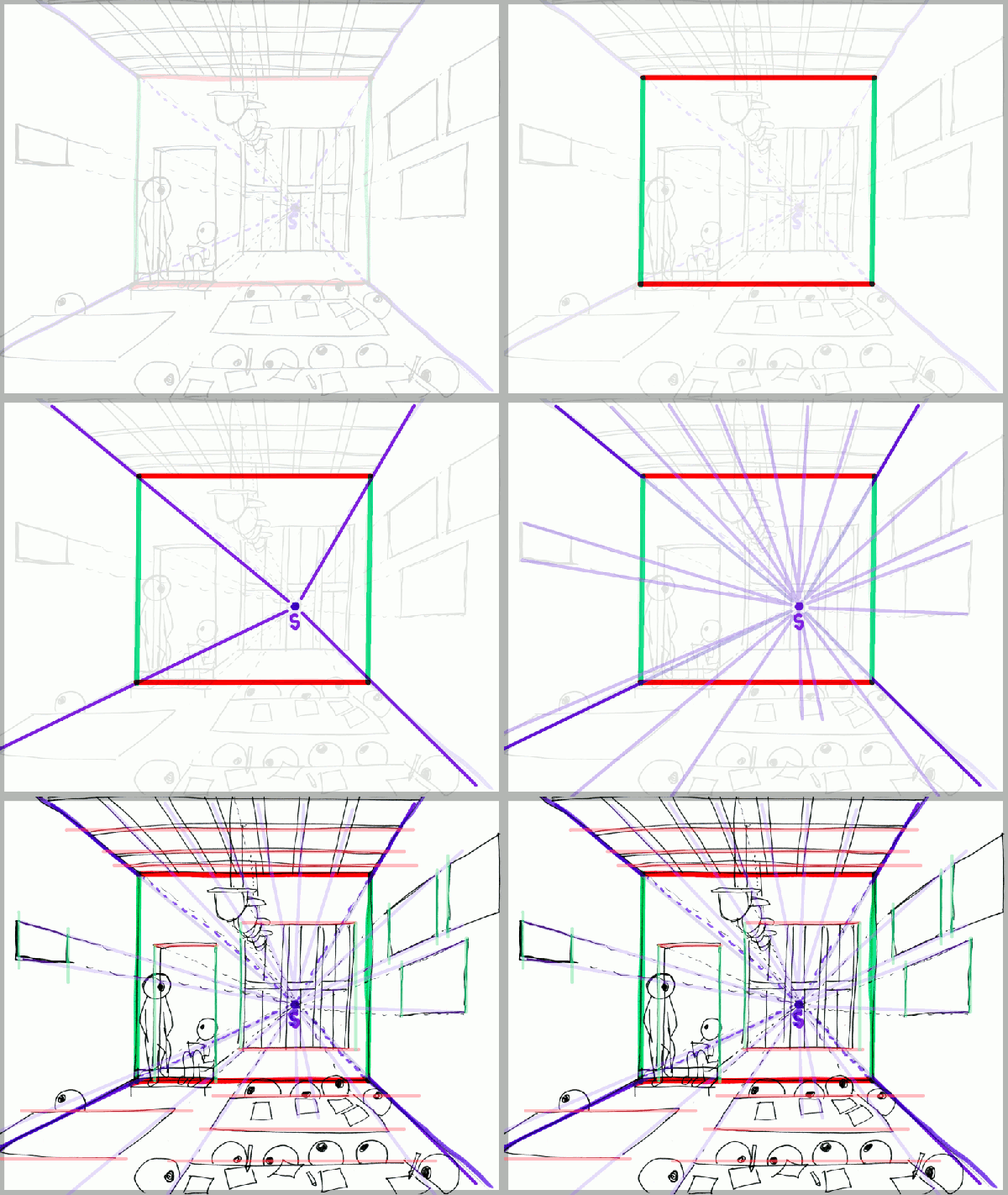
I start my demo by looking at the FAR WALL of a rectangular room, & drawing its rough outline on my blank page:

- For this demo, I’ll draw all HORIZONTAL edges in RED🔴 and VERTICAL edges in GREEN🟢.
Next, I place a vanishing point (VP) at infinity — The distance where EVERYTHING is too small to see, & the whole universe appears as a single point:
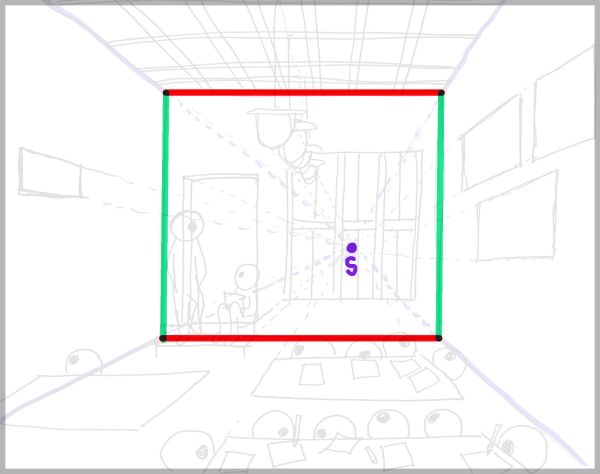
- Since I’m using single-point perspective, this image will have only ONE VP.
- I’ve marked this VP as “S” because I’m looking to the SOUTH.
- Also, it’s slightly off-center (& low) because I’m slightly off center & low in the space of the room.
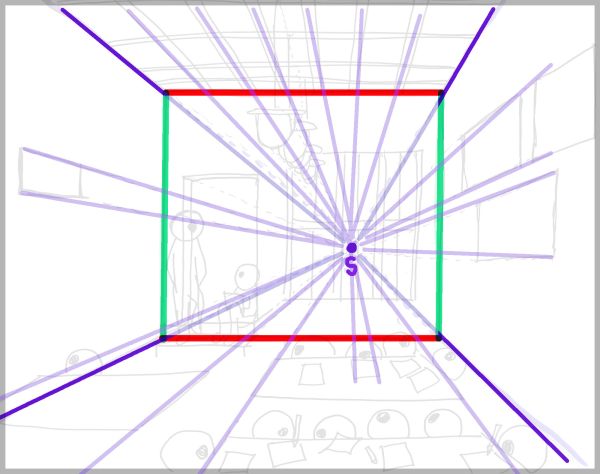
Now I can depict all DEPTH edges (running out of & into the picture, towards & away from me) in PURPLE🟣 — Here are the 4 depth edges along the room’s corners:

Here are several other depth edges of frames, tables, etc.:
Now I’ll complete these objects by adding in horizontals (red, left) & verticals (green, right):

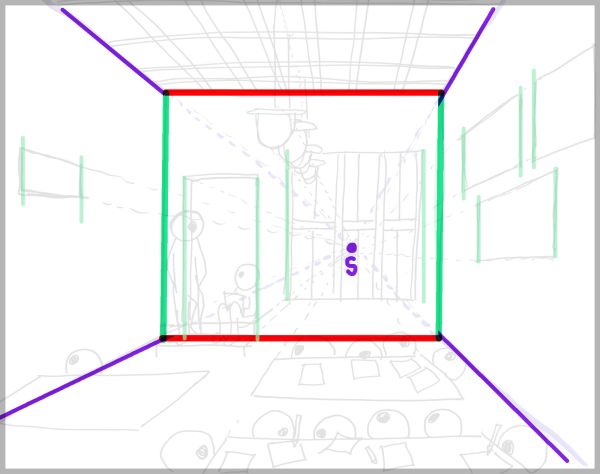
Here are all those edges together:

Now I’ll add ink & some eyeball observers:
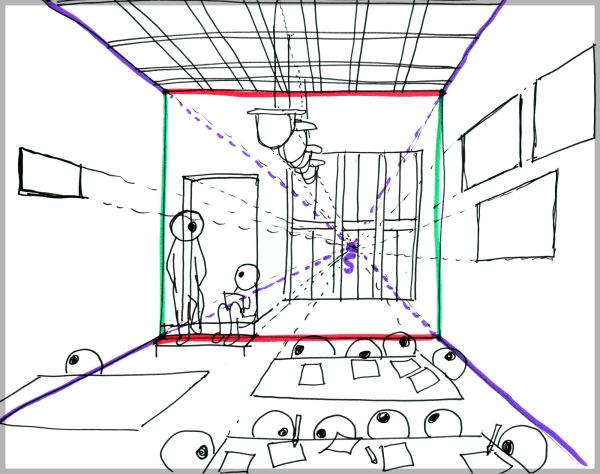
Here’s an animation showing that same basic process:
LIMITATIONS:
Here’s the thing — Linear perspective can give us a sense of depth, but it often feels like a view from afar, from OUTSIDE the space depicted:

It can even look like a view of a distant stage! That’s because linear perspective follows the “rules” of perspective at a distance, where the distances BETWEEN details are a small proportion of their distance to your eye.
If we want to get up-close & immersive with our image, we’ll need a different approach… That’s when I reach for CURVILINEAR PERSPECTIVE👉!
MORE PERSPECTIVE POSTS:

PERSPECTIVE COMICS #1 👁 Brunelleschi Draws (Florence / 1415)
Filippo Brunelleschi re-discovers ancient techniques of linear perspective… (Drawn w/ 5th graders @ a CLiF residency!)
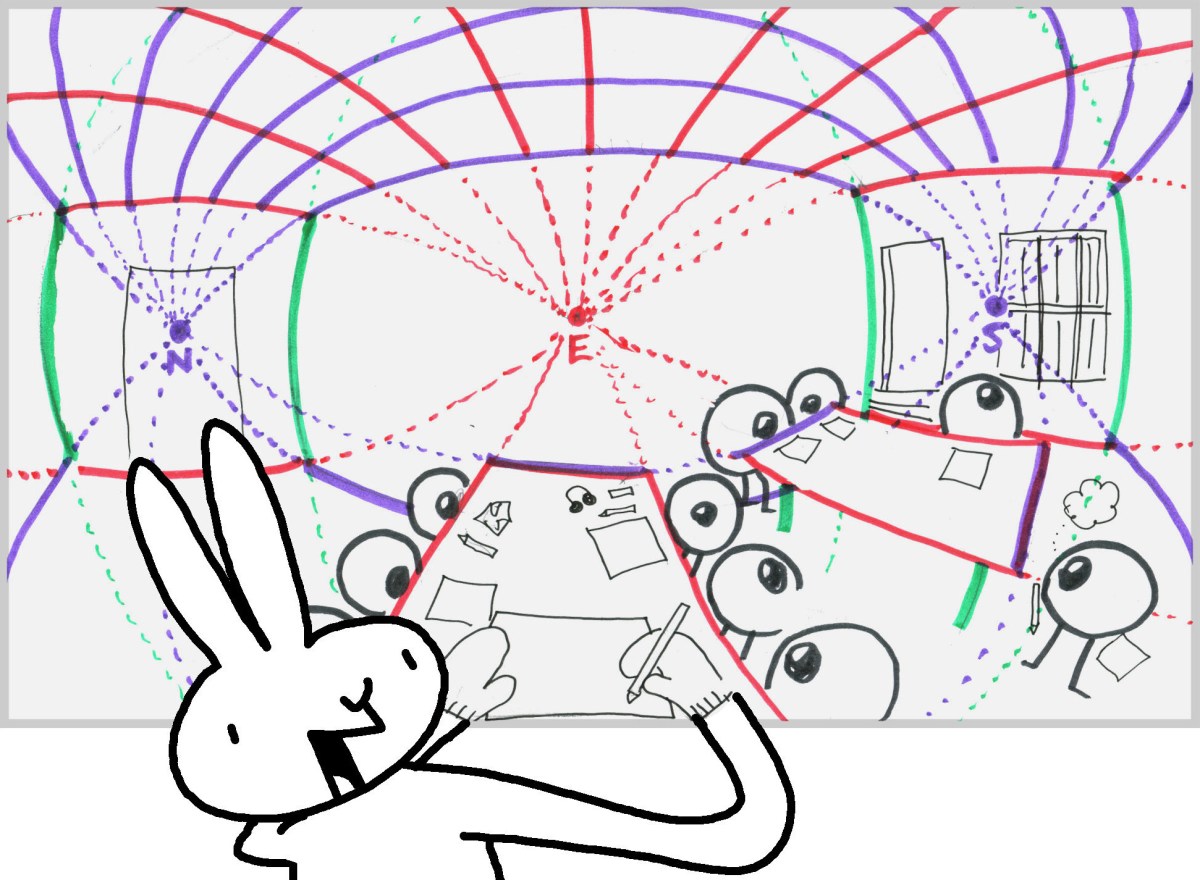
Curved/Panoramic Perspective🌎👀 (Sketchbook Demo)
An immersive way of seeing (& depicting) a 3D space…

DC SKETCHBOOK 👁🗨 January 2025
Selected pages drawn in snow & sun at the USA’s capital city!
Something went wrong. Please refresh the page and/or try again.
Thanks to Champlain College for hosting the original demos of these techniques!


Discover more from http://www.MarekBennett.com
Subscribe to get the latest posts sent to your email.

Leave a comment